သမုိင္းအေထာက္အထားအမွန္ကုိသာတင္ၿပထားပါသည္။
Showing posts with label Nwes. Show all posts

Thursday, November 22, 2012

Suu Kyi and Obama

 Mg Thit Sar's photo.
ဟူစိန္ဘိုင္က ဘယ္တုန္းတည္းက ၾကံ စီ ထားလည္း မသိဘူးဗ်ာ...ေတြ႕ တာနဲ႕ အားရပါရပါဘဲ...

ကဲ အေမာင္ ၀ိရသူ ျမန္မာ မိန္းကေလး လူထု ေခါင္ေဆာင္ၾကီးကိုယ္ေတာင္ ကုလားဟူစိန္က အားလံုး အေရွက မွ နမ္းျပ ေနတယ္ ခင္ဗ်ား ဘယ္ လို အေရး ယူ ေပးမလည္းဗ်ာ.....
ဟူစိန္ဘိုင္က ဘယ္တုန္းတည္းက ၾကံ စီ ထားလည္း မသိဘူးဗ်ာ...ေတြ႕ တာနဲ႕ အားရပါရပါဘဲ...

ကဲ အေမာင္ ၀ိရသူ ျမန္မာ မိန္းကေလး လူထု ေခါင္ေဆာင္ၾကီးကိုယ္ေတာင္ ကုလားဟူစိန္က အားလံုး အေရွက မွ နမ္းျပ ေနတယ္ ခင္ဗ်ား ဘယ္ လို အေရး ယူ ေပးမလည္းဗ်ာ.....

Wednesday, November 21, 2012

Burma: Satellite Images Show Widespread Attacks on Rohingya

Obama Should Press Thein Sein to End Sectarian Violence
November 17, 2012
President Obama should make clear to the Burmese president that the attacks on the Rohingya need to stop if the Burma government wants to avoid renewed sanctions and the suspension of renewed military-to-military dialogues with the United States. This is crunch time because Burma’s failure to contain sectarian violence in Arakan State and hold accountable those responsible calls into question the Burmese government’s stated goal of becoming a rights-respecting, multi-ethnic state.
Brad Adams, Asia director
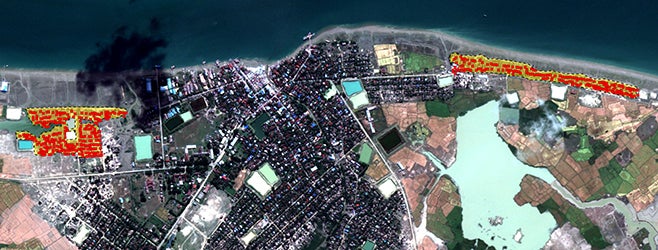
(Bangkok) – Attacks and arson in late October by ethnic Arakanese against Rohingya Muslims in Burma’s Arakan State were at times carried out with the support of state security forces and local government officials, Human Rights Watch said today. New satellite imagery obtained by Human Rights Watch shows extensive destruction of homes and other property in the predominantly Rohingya Muslim areas of Pauktaw, Mrauk-U, and Myebon townships, all sites of violence and displacement in late October 2012.
Rohingya and Arakanese residents of Pauktaw and Mrauk-U townships described to Human Rights Watch the sectarian attacks and arson that occurred in those areas on October 23 and 24, which in some cases involved state security forces. Similar violence between Arakanese Buddhists and Rohingya and non-Rohingya Muslims, also involving state security forces, occurred in seven other townships in late October.
US President Barack Obama is scheduled to make a one-day visit to Rangoon on November 19 to meet with Burmese President Thein Sein and opposition leaders.“President Obama should make clear to the Burmese president that the attacks on the Rohingya need to stop if the Burma government wants to avoid renewed sanctions and the suspension of renewed military-to-military dialogues with the United States,” said Brad Adams, Asia director at Human Rights Watch. “This is crunch time because Burma’s failure to contain sectarian violence in Arakan State and hold accountable those responsible calls into question the Burmese government’s stated goal of becoming a rights-respecting, multi-ethnic state.”

In satellite images of four townships in Arakan State that experienced violence in late October and in the state capital, Sittwe, which experienced violence in June, Human Rights Watch identified a total of 4,855 destroyed structures. These images show zones of documented destruction covering 348 acres of largely residential areas predominantly home to Rohingya Muslims who have since fled and to Kaman Muslims in Kyauk Pyu.

The images, which were captured on November 3 and 8, are not exhaustive and reflect damages in only five of the thirteen townships that have experienced violence in Arakan State since June.Rohingya from Pauktaw now at camps near Sittwe told Human Rights Watch that for weeks they faced hostile Arakanese mobs, sometimes led by Buddhist monks, who threatened violence against them and anyone else found selling or providing the Rohingya with food or other assistance. They said they repeatedly notified local authorities of these threats, but insufficient action was taken. In late October, just prior to the violence, Rohingya were called to a series of community meetings held by local Arakanese members of a nationalist political party and local government officials apparently aimed at convincing the local Muslim population to abandon their homes.

On October 23, when boats filled with several hundred armed Arakanese descended on the riverside Rohingya villages in Pauktaw, the Rohingya fled, fearing for their lives, and their villages were razed.

Displaced Rohingya and Kaman Muslims told Human Rights Watch that some members of the state security forces provided them temporary protection at various points in late October – for example by firing shots in the air to fend off hostile Arakanese mobs, or by providing water and food to their boatloads afloat offshore who were being denied permission to come ashore in Sittwe. But these instances of protection were offset by violence committed against the Rohingya and Kaman by other groups of security forces. For example, on October 26, soldiers from Nasaka, a government border guard force under the command of the army, severely beat dozens of displaced Rohingya who had clambered off boats on to the shores near Sittwe.
The new satellite imagery shows near 100 percent destruction of Yan Thei village in Mrauk-U Township. Witnesses told Human Rights Watch that Arakanese mobs armed with swords, spears, homemade guns, bows and arrows, and other weapons descended on the village on October 23, and fighting ensued. The Rohingya were ultimately surrounded and overwhelmed, and survivors fled by land to an area outside the village. Gruesome casualties were sustained on both sides, including beheadings and killings of women and children.
After October’s violence, there are now more than 110,000 internally displaced persons in Arakan State, nearly all Rohingya Muslims. “People are still coming every day,” a displaced Rohingya near Baw Du Ba displaced person camp told Human Rights Watch.

Yan Thei Village, Mrauk-U Township: Pre-attack View of Village
Yan Thei beforeYan Thei Village, Mrauk-U Township, on 11 February 2012. Pre-attack view of village in satellite image. Damage Analysis: Human Rights Watch; Image © DigitalGlobe 2012; Source: EUSI

Yan Thei Village, Mrauk-U Township: Post-attack View of Village
Yan Thei afterYan Thei Village, Mrauk-U Township, on 3 November 2012: Post-attack view of village in satellite image with annotated building damages.
Damage Analysis: Human Rights Watch; Image ©: DigitalGlobe 2012; Source: EUSI


The displaced Rohingya populations from the sites of destruction depicted in the new satellite images are in dire need of shelter, food, water, sanitation, and medical care, Human Rights Watch said.The displaced from Pauktaw have been forced to seek refuge in beachside coastal areas outside Sittwe, in treeless, makeshift camps under the hot daytime sun without adequate food, potable water, and other necessities. One makeshift camp with an estimated 1,200 displaced persons lacks latrines and the group is subsisting primarily on donations from nearby Rohingya villages, which themselves struggle to survive. Some of the displaced had tarps for shelter bearing the logo of a United Nations agency that they said they purchased from local merchants.

Burmese security forces have restricted the access of international humanitarian agencies to the area and to even more remote coastal areas where others from Pauktaw are seeking refuge. Since their arrival some displaced persons reported they have been beaten by local security forces.
The displaced Rohingya from Yan Thei are likewise in dire need of aid, Human Rights Watch said. They are living in makeshift shelters outside their now razed village. According to the displaced, there has been no sustained international access at their camp, and government officials are not permitting them to leave the area. Burmese government officials have provided only a limited amount of aid.
Groups of displaced Arakanese Buddhists from Yan Thei have sought refuge in two monasteries in Mrauk-U town, where they appear to have received sufficient amounts of aid from the local Arakanese community. Unlike with the Rohingya, the government is not restricting the movements of ethnic Arakanese.
While violence had not affected Mrauk-U Township in June, there was previous violence in Pauktaw. According to local accounts, approximately 14 homes in Pauktaw were burned down in June. Villagers told Human Rights Watch the previous arson and subsequent threats and incidents of violence were clear indications of the risk of future violence.
“The satellite images and eyewitness accounts reveal that local mobs at times with official support sought to finish the job of removing Rohingya from these areas,” Adams said. “The central government's failure to take serious action to ensure accountability for the June violence fostered impunity, and makes it responsible for later attacks not only when security forces were directly involved but also when they weren’t.”
The Rohingya have faced decades of state sponsored discrimination and abuses. Burma’s 1982 Citizenship Law effectively stripped the Rohingya of citizenship, rendering them stateless.

Human Rights Watch previously released satellite imagery showing extensive destruction of homes and other property in a predominantly ethnic Kaman Muslim area of the coastal town of Kyauk Pyu, identifying 811 destroyed structures on the eastern coastal edge of Kyauk Pyu following arson attacks conducted on October 23 and 24. The area of destruction in Kyauk Pyu measures 35 acres and includes 633 buildings and 178 houseboats and floating barges adjacent on the water, all of which were razed.

Human Rights Watch investigations found that local security forces killed ethnic Kaman Muslims in Kyauk Pyu while soldiers from the Burmese army stood by and watched. Members of the Muslim community in Kyauk Pyu also attacked and in some instances killed ethnic Arakanese before fleeing by sea toward Sittwe.“The Burmese government needs to get serious about addressing the root causes of the sectarian violence in Arakan State, including Rohingya statelessness,” Adams said. “The absence of accountability for this horrific violence gives a green light to extremists to continue their attacks and abuses.”

Background
All four districts of Arakan State – Sittwe, Maungdaw, Kyauk Pyu, and Thandwe – have experienced violence since June 2012. Violence between Arakanese Buddhists and Rohingya Muslims reignited on October 21 and continued to some extent all week in 9 of the state’s 17 townships: Pauktaw, Mrauk-U, Myebon, Kyauk Pyu, Ramree, Kyauktaw, Minbya, Rathedaung, and Thandwe. Four other townships experienced serious violence in June and thereafter: Sittwe, Maungdaw, Buthidaung, and Toungop. Many of the places targeted in October had not been attacked in the earlier round of sectarian violence that consumed Sittwe and other parts of northern Arakan State in June. The sectarian violence that erupted in Arakan State in June devastated both Arakanese Buddhist and Rohingya Muslim communities, both of whom lacked protection from security forces.

Thursday, August 23, 2012

Indonesia muslim Protest for the Rohingya


Older Posts

Wednesday, August 22, 2012

RNDP ႏွင္႔ ၿပည္ေထာင္စုေရြးေကာက္ပြဲေကာ္မရွင္ ေဆြးေႏြးခ်က္ မွတ္တမ္း

အားလုံး(၆)မ်က္ႏွာရွိ၊(၁)မ်က္ႏွာလုိ

ကနက္ရွင္ေကာင္းလွ်င္တင္ေပးမည္။


1
2
3

4
5

Friday, May 18, 2012

ARNO President interview on recent situation of Rohingya and Burma


Mr. Nurul Islam, the president of Arakan Rohingya National Organization (ARNO) based in London who had given an interview on recent situation of Rohingya after Thein Sein’s new government’s reform process towards the democracy.


Mr. Nurul Islam, the president of Arakan Rohingya National Organization (ARNO)

KPN: The Thein Sein’s new government held meetings with ethnic groups such as - Karen, Mon. Rakhine, Shan, Chin and Kachin--etc, but the government excludes the Rohingya community. Regarding this, what is your opinion?

ARNO: The exclusion of Rohingyas asserts that U Thein Sein government has no change of attitude towards them. It is still pursuing policies of exclusion, discrimination and persecution against Rohingyas. We remind the government that Rohingyas are an integral part of the Burma’s society regardless of their appearance, ethnicity and religion.

KPN: The Rakhine community has been campaigning against the Rohingya community inside Burma and abroad. Do you think that there will be any solution between the two communities, why?

ARNO: Rakhines are our immediate compatriots and they are our brothers. We had lived in Arakan peacefully in share and share alike. Still we are living in the same place drinking the same water and breathing the same air; not only so but we have to live together until the end of the world. Arakan is our own whereas Burma is for all of us. Together we can achieve much. We should take lesson from the history. It is futile exercise to preach and promote hostility against Rohingyas. Extremism, xenophobia and confrontation will not be of assistance to Rakhine people. It is time not to dispute but to work in unison with full understanding which will lead our children to a state of extreme happiness. Based on ‘Arakan reality’ peaceful coexistence between our two sister communities is the only solution. It is very much possible. They only thing we all need is ‘will to do’.

KPN: There are some changes in Burma after the new government, but no policy is changed over the Rohingya people and the persecutions against the Rohingya community is going on bad to worst day by day. Regarding this, what is your comment?

ARNO: Yes, there are some positive changes in Burma. But so far no wind of change has touched the Rohingya people. It means that good sense does not prevail yet in the minds of the authorities. Nowadays the Rohingyas have to experience series of racist and xenophobic activities of the government and non-state extremists. They are not treated as citizens and the persecution against them callous. End to persecution and discrimination against Rohingya is a yardstick for judging how far U Thein Sein government is sincere towards restoration of democracy and promotion of human rights in Burma. The government must genuinely accommodate ethnic Rohingya in country’s democratic and political process as one of the members of the family of the Union of Burma. A peaceful negotiated settlement of the Rohingya issue and problem is most urgent in the interest of peace and democracy in Burma.

KPN: Regarding all the above situations, especially for the Rohingya community, what are your future plans and programs and what do you want to say to the present government, NLD and the international community?

ARNO: The primary factor that has led the Rohingyas to suffer grave human rights violations or crimes against humanity in Burma is their religion and ethnicity. Arbitrary deprivation of Rohingyas’ citizenship, rendering them stateless in their own homeland, is an international crime. We will continue our just struggle for freedom from servitude and oppression. We will work in solidarity with country’s democratic forces. We will explore all available national and international avenues for the restitution of our inalienable rights and freedom.

We wish to be responsible citizens of the country and urge upon the government to treat Rohingyas justly and reasonably well. It requires to genuinely accommodating Rohingyas as one of the many ethnic nationalities of the Union of Burma and treating them equals in Arakan. It is urgent that the repressive 1982 Burma citizenship Law in particular, which violates several fundamental principles of customary international law standards, must be amended in conformity with the generally accepted citizenship practices and provisions of international law. Rohingya should be legitimately allowed to be a part of the on-going political and democratic process, and their citizenship rights and ethnic rights have to be guaranteed on par with other ethnic groups of the country.

We have high expectation of Daw Aung San Suu Kyi. But she has been, so far, surprisingly silent on the Rohingya issue, a problem of serious human rights violations in the country. As a democratic icon we urge upon her to speak out for the voiceless Rohingyas on democratic principle and universalism of human rights.

Meanwhile, we call on the International community, UN, OIC, EU, ASEAN, UK, and Burma’s neighbours to put pressure on the ruling Burmese government to stop forthwith persecution against Rohingya and to grant their citizenship and ethnic rights. We also urge upon them to provide them with ‘international protection’ in the absence of ‘national protection’.

KPN: What is your opinion about the participation of NLD parliament members in recently held parliament in Naypidaw, in Burma?

ARNO: It is a development in Burma politics that Daw Aung San Suu Kyi and NLD MPs are participating in Parliament Naypyidaw, although they are likely to face a difficult future to being about a complete change towards democratic reform.
KNP

Dhaka proposes Rohingya issue in OIC


Chittagong, Bangladesh: The Bangladesh Foreign Minister Dipu Moni in her statement highlighted the issue of Burmese refugees- Rohingya refugee- being hosted in Bangladesh for the last two decades and put forward some concrete proposals to address the issues in the First International Ministerial Conference on Refugees in the Organization of the Islamic Cooperation (OIC) – the Muslim World- began in Ashgabat, Turkmenistan on May 12, according to a press release from the ministry.
 
“The proposals include the requirement of international dialogue and engagement with non-OIC countries; addressing the root causes of protracted refugee situation; and strengthening the principle of international burden-sharing — considering the shrinking global space for asylum and a growing trend of asylum fatigue.”
The Foregin Minister also mentioned that the refugee problem imposes disproportionately heavy burden on host countries, who generally belong to the under developed country category or least developed countries (LDCs) like Bangladesh.

The foreign minister underscored engaging the host countries in decision-making and gap analysis relating to refugee protection, and stressed that their financial and associated economic contributions should be accounted for in the “official” discourse on protection.

Urging the UNHCR to take the lead role, Dipu Moni opined that the OIC could be a political partner in that dialogue.

Foreign Minister Dipu Moni May 13, urged the United Nations High Commissioner for Refugees (UNHCR) António Guterres to resume repatriation process of the Burmese refugees in Bangladesh on the sidelines of the Organisation of the Islamic Cooperation (OIC) Ministerial Meeting at Ashgabat, Turkmenistan, the press released said.

But, the Guterres opined that there might be some differences in understanding between the UNHCR and the government of the countries concerned about different aspects of Rohingya refugee problem.

“To clarify the issues, the Bangladesh government may consider sending a team to Geneva or the UNHCR may send a team to Dhaka,” Guterres said.

Dipu Moni preferred a latter option and requested the UN refugee agency chief to adequately sensitize the UNHCR Dhaka office to take necessary measures to resume the repatriation process that has been stalled since 2005.

The two-day meeting is the first of its kind under the aegis of the OIC (Organization of Islamic Cooperation) where UN High Commissioner for Refugees (UNHCR) is one of the co-organizers according to a press release from the ministry.

Similarly, Department of International Relation of Chittagong University (CU) organized a two-day lectur session in collaboration with the United Nations High Commissioner for Refugees (UNHCR) sub-office in Chittagong to give the students a practical knowledge about the Rohingya refugees and their miserable condition, Chittagong University (CU) on May 12, according to CU Department of International Relation’s statement.

Dirk Hebecker, head of UNHCR sub-office in Cox’s Bazaar, was the key lecturer on the first day of the programme and explained about the origins of the Rohingya refugees of Bangladesh, their problems and challenges.

Fahmida Karim, an official of UNHCR Dhaka office, and Faridul Alam, chairman of International Relation department of CU, were also present at the programme.